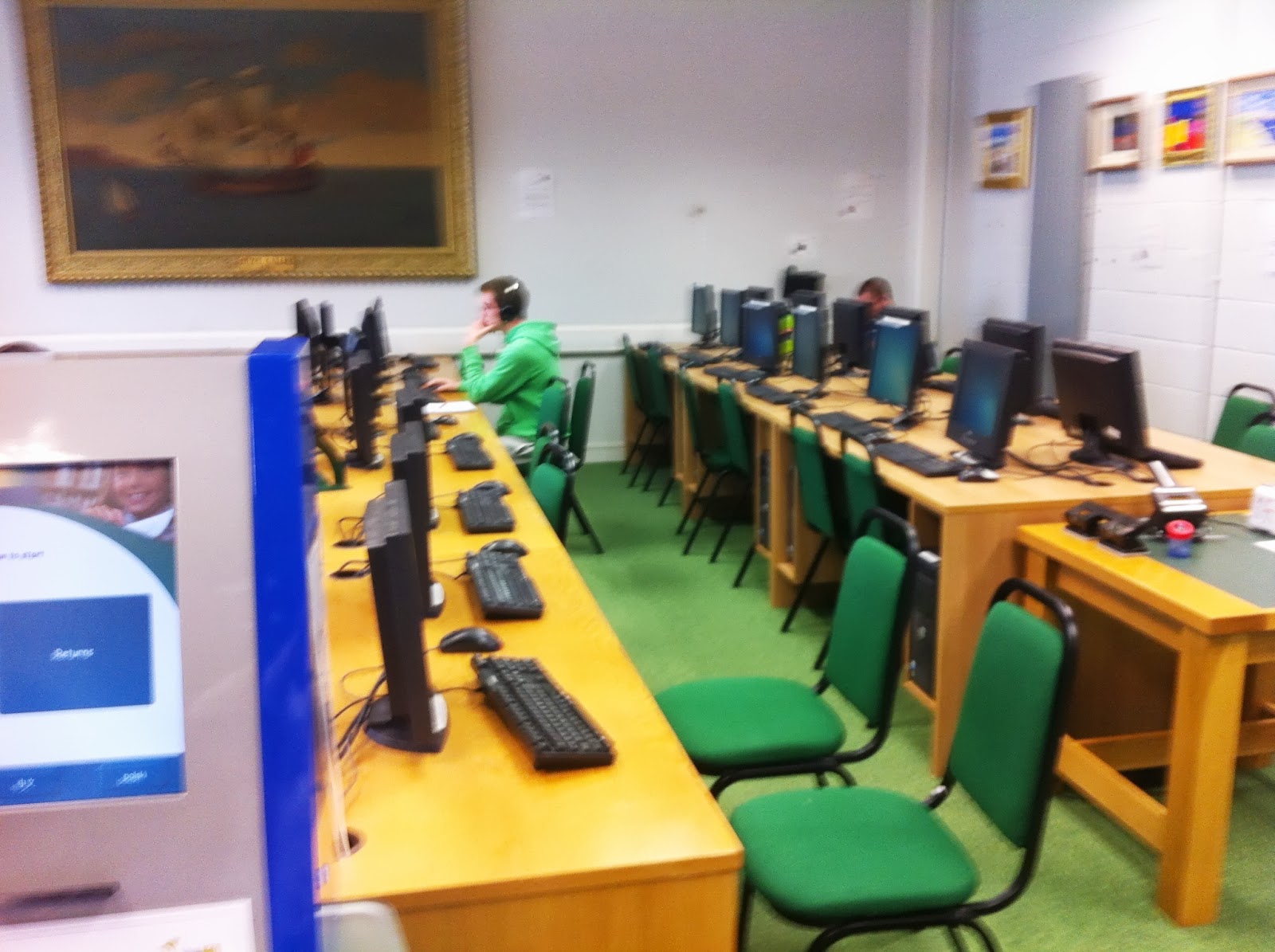
Monday, 2 September 2013

Inculsion of Search Boxes on Library Homepages - An Overview

When evaluating the library home page for a new design, I reviewed the inclusion and search targets of the search boxes on the library homepages of Libraries identified on Librarytechnology.org as having both Millennium and Summon, and Irish Academic Libraries irrespective of ILS or RDS. Where no box was immediately evident, but a link offered, this is noted in the table below.

Millennium is the library management software, and Summon is a resource discovery layer.  Both are used to provide search options to library web site users for locating print and electronic information.
Where another interface is offered instead this is noted. There is a clear trend to offer search on tabbed content or links, as opposed to search boxes on the homepage (14 sites)

Homepages were visited in July 2013.

Overview results

Institution

Library OPAC

Summon 

Other 

Comment

Brown University VuFind
Darlarna University * Summon only
Dartmouth College One Search Parsed records,
with three results columns:
Summon, Library
Catalogue, Library Web Site.
Fairfield Search options offered on tabs,
with addtional information on
mouse roll over 
Middlebury College Tabbed search option 
Murdoch University * Summon only
Queensland University of Technology * Customised with check
boxes for all, articles, etc.)
Temple University Search Tabs
University of Houston Lefthand menu - very clear
University of Miami Search Tabs
University of Nevada Popdown menu
University of North Carolina, Chapel Hill Search tabs including Google Scholar
includes options for articles and catalog
University of Tasmania Tick boxes  then databases, journals,
catalog (keyword & classic)
and help. Then explore more,
 includes, citation finder,
and ILL core tools.
Victoria University * * Search options listed, summon, book
and e-books, and journal articles
University College Cork Search Tabs
Trinity College Dublin Search Tabs
University of Limerick Search Tabs
NUI Galway One search box, with more options
Dublin City University Search tabs
NUI Maynooth Search tabs
GMIT * and Google custom search
AIT Search tabs
ITB * * via tick boxes
ITC *
CIT * *
IADT Search Tabs
DKIT *
LYIT *
LIT *
Sligo IT * Search tabs
ITT Dublin * search tabs Summon branded Find IT
ITTR * Link to summon
WIT * Link to summon
DIT * Link to summon


Wednesday, 7 August 2013

FRAD - Functional Requirements for Authority Data A Conceptual Model - Now available via open access

Title details:
Functional Requirements for Authority Data 
A Conceptual Model 
IFLA Working Group on 
Functional Requirements and Numbering of Authority Records (FRANAR) 
Final Report 
December 2008 
Approved by the Standing Committees of the 
IFLA Cataloguing Section and IFLA Classification and Indexing Section 
March 2009
As amended and corrected through 
July 2013

IFLA cataloguing section newsletter published - FRBR updates included.

SCATNews
Newsletter of the Standing Committee of the IFLA Cataloguing Section
Number 39 ISSN 1022-9841 June 2013
http://www.ifla.org/files/assets/cataloguing/scatn/scat-news-39.pdf
  • Susan R. Morris - News from the Library of Congress
  • Gordon Dunsire  Update on cataloguing namespaces
  • Francois-Xavier Pelegrin - FRBR models and serials: release of version 0.1 of the PRESSoo model
  • Pat Riva  - FRBR Review Group, a retrospective and update
  • Mirna Willer  - ISBD: information on the activities so far, and the reasons for attending to it...

Monday, 8 July 2013

IIUG Systems Pre-Conference 13/6/2013

The Systems Pre-conference, consisted of a Systems Librarians' meeting chaired by Margaret Waldron, Institute Librarian, at GMIT, and a series of presentations about systems projects undertaken to expand the capacity of the library system. (IIUG is the Irish Innovative Users Group who use the Millennium or Sierra systems. See more at http://irishinnovativeusersgroup.blogspot.ie/ )

Outcomes from the meeting included the setting up of a share wiki https://sites.google.com/site/iiugsystemslibrarians/  for the systems librarians, and the decision to approach HEANet for training re EDUGATE usage statistics. The share wiki is private and only available to users by invitation. All members are asked to share one systems related document. Details were posted to the IIUG Systems Librarians Google Group. https://groups.google.com/forum/?hl=en&fromgroups#!forum/iiugsystems
I have added our systems administration task list.

It is hoped to use Google hangout to exchange experience later in the year.

The afternoon as dedicated to presentations

Gary Cullen from LYIT spoke about their SMS texting solution

 for circulation notices. This solution was put in place following the observation that the students were not reading their notifications. It was decided o try SMSing them in addition to the e-mails automatically generated by the system. These notices were copied to a dedicated e-mail inbox and utilized by a custom script to populate data fields into the sms's to be sent. A second year computing student undertook the scripting work, working closely with the library. The selected SMS provider is an incubator business at LYIT, and costs significantly less than the III provider in the UK. c. 200 texts per month are sent. Students opt in at registration, for data protection purposes.


Elaine Doherty from DIT spoke about their OPAC refresh project in 2012. 

This was a very structured overview of the processes used and decision making processes employed. A fresh uncluttered look as implemented as a result of the project. The homepage looks simpler while offering more search options. A cross-browser design was implemented, using the firebug extension for Firefox. Useful resources included the Webpac WIKI and Sue Boggs IUG presentation.

Catherine Sanborn from UCC spoke about their implementation of Print Templates

, and resources that are available for implementing them locally and on the III web sites. The print template wiki was mentioned. Advice included starting with someone else's templates to see what they had done (TCD have loaded theirs onto the wiki). Notepad and iReport can be used to edit the templates, however it is important not to rename the files or they won't work. 

Friday, 21 June 2013

Visit to Beautiful Ballyroan (Library) 21/6/2013

We visited Ballyroan Public Library today to look at their flooring, and their beautiful new library...

Tuesday, 18 June 2013

Trust and Digital Preservation - RIA 4th June, 2013.

I attended the first day of the Trust and Digital Preservation workshop at the RIA on the 4th of June 2013. It was a very busy day with a lot of very specific information at the start. Eventually we got to examples of digital preservation projects, and trust certification routes. These are my headline notes from the day, and are not necessarily in chronological order. #DPTrust was used on the day. 

I decided to only attend day one, as I am new to the whole area. The high level of content on day one reinforced this decision.

Trust is one area of concern in relation to Digital repositories  the others are Sustainability, Usability and continued Access. 

Trust: can be certified. A certification of trustworthiness path is laid out, depending on the level of commitment, local expertise and import of the digital collection preserved different levels may suit different repositories. 

Activities in this area re being led by APARSEN , 
APARSEn is finded from the EU's 7th Framework from 2011-4 and aims to unify diverse organisations and practices within the field encouraging coherence, cohesion and continuity. The Virtual Centre for Digital Preservation Excellence (VCOE) will provide online training.  A formal qualification is being considered. 

Digital Repository of Ireland focuses on contemporary historical, social and cultural data in Ireland. It is interactive and trusted. HEA PRTLI5 funds it until 2019. They have created a report - Digital Archiving in Ireland. The OAIS model is used (ISO 14721). Advice; Don't preserve everything - the organisation needs to decide strategically what should be preserved. (Also discussed were, OA to Metadata, DOI minting, PID's, file formats, IP/Copyright Issues)

Authenticity and Provenance of digital data is important. As a concept Trust has been used and abused, so be careful how you approach this topic. It is not blind or and act of faith. Depositors and End Users need to be able to trust the custodian/curator. Reliability is key. Core elements to trust are reputation, performance, competence and confidence which should be built into workflows and procedures. The level of trust required varies with the relative sensitivity of the nature of the materials. Librarians have good concepts and standards for this. (Also discussed InterPARES, CASPAR, SCIDIP-ES, PREMIS, ISO 15489 and ISO 16363 )

Ethical concerns were discussed as a barrier to the submission of data to repositories. The issue becomes how to protect and share this data, especially as the permission needed from participants in a research sample become more complicated over time. ON the other hand, not all data is sensitive. Anonymization has it's place (Levels of this were also discussed). Another issue is ethical committee mismatches to the research proposed. Informed consent V. invasion of Privacy. IQDA webpage was discussed. It was noted that solely digital storage is not reliable and that researchers should be encouraged to have three sources including one off site, and a paper copy. 

To encourage trust it should be mentioned explicitly in mission statements, indicating dedication, then the repository should do what it promises in this statement, building a reputation for trustworthiness, and be transparent, looking for peer-review and certification. 
There are standards of trust. See UK digital archive. These include the Data Seal of Approval. as the entry point for certification of trust. (Also mentions DANS, DIN,  NESTOR)
ISO  16363  and din 31644. Test auditing is due in 2013. 
ISO 16363 uses 100 metrics, the OAIS model and includes a full external audit by peers. 
Audit specification are still being finalized and training has yet to be undertaken by auditors. 
Data Seal of Approval was suggested as being sufficient for small repositories  while ISO/DIN would be appropriate for larger ones. RDA Group on Certification was mentioned in this context.

It was argued that trustworthiness is not an illusion. 

An overview of activities in this area since 2002 was given. ISO 16919 re auditing is in draft format. Also mentioned PTAB , CCSTS, RAC. Trusted Digital Repository EU


Any errors are my own please inform me of any and I will correct them!